Valve released the new Dead Hand Terminal, along with 17 completely new skins! Including the amazing Desert Eagle Firebreathing. We talked to the creator of this skin – React. In a fresh interview for the CS.MONEY Blog, the skin maker shares his long path before first accepted skin, and talks about inspiration and current state of CS2.
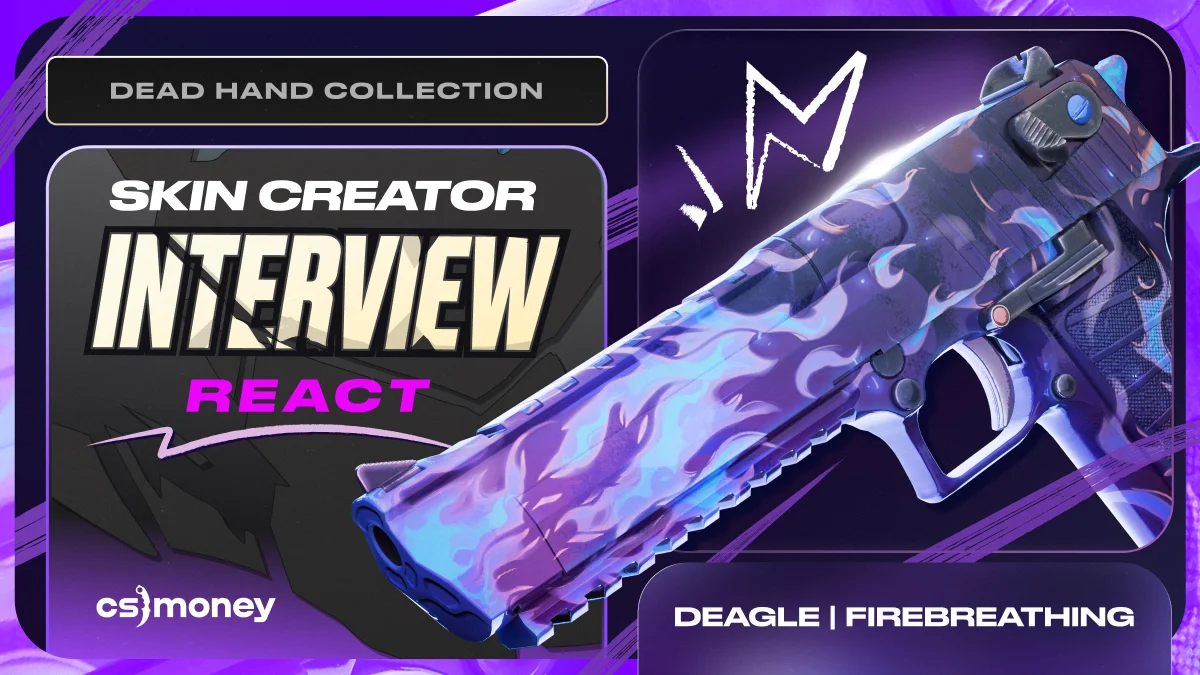
React talks about:
- The new Desert Eagle Firebreathing skin
- The Terminal system
- Skin maker earnings – and the price of success
- And much more!
Welcome to CS2!
So, this is your first skin! How does it feel?
I’m honestly very happy. I’m happy that I’ve finally been officially recognized as a skin creator after such a long time. My reaction was mixed at first: I was a bit down because my neighbors didn’t let me sleep, but after a couple of hours I felt a huge wave of euphoria! I’m glad I’ve left my mark on the game series I’ve been playing and loving for 13 years.
Tell us about it – it’s basically a mix of Blaze and Printstream! Have your friends congratulated you yet?
A lot of people congratulated me, and they’re genuinely happy that I got into the Terminal! I love them all and I’m endlessly grateful for the incredible support they gave me throughout the whole journey!
What do you think about the Terminal system? It’s definitely not the usual case system.
All I think is that the guys at Valve are really smart, and if they built such a massive private company, they probably are not going to shoot themselves in the foot. I am sure terminals are a new, unique, and most importantly, profitable type of monetization.
Strenson told us in an interview that Valve pays a fixed amount for a skin in the Terminal. Is that still true? Are you okay with that?
Yeah, word has been going around the internet for a while that Valve pays a fixed amount now. It is not a bad way to monetize your art. For beginners and newcomers, it is a huge motivation and, potentially, good money.
However, this only really works for newcomers and those who just want some extra cash for things they want. I am guessing more experienced skinmakers who have been working for years are not that interested in terminals.
It is nice when a hobby brings in income. But if I had received royalties for my six years of hard work, I would be way happier. That does not mean I am not glad! I am still satisfied I will get a payout.
The path of a skin maker
Is making skins your main job?
Making skins is my hobby. I could not quit my day job just to make skins. Though, I know some people who went all-in. Some made it, some gave up. It is such an interesting hobby; when you first find out about it, you just want to get into the game. Then, when you start mixing with the community and realize how much accepted creators make, a fire lights inside you and you want to get that coveted checkmark no matter what. But it is all so deceptive.
Behind all those green checkmarks are sleepless nights, designing unique concepts, learning software and pipelines, studying new things, guessing about the next case, changes in payment systems, insane competition for a spot in a case or terminal, waiting half a year just to get skipped again, joy, envy, and so much more.
Some guys say, like, it is just a hobby. Why push yourself so hard if no one has to accept your work? But it is not exactly a simple hobby. It is a hobby that can radically change your life for the better by doing what you love. That is why for all the workshop regulars, skins are not just a hobby, but a goal and a dream they are ready to sacrifice a lot for.
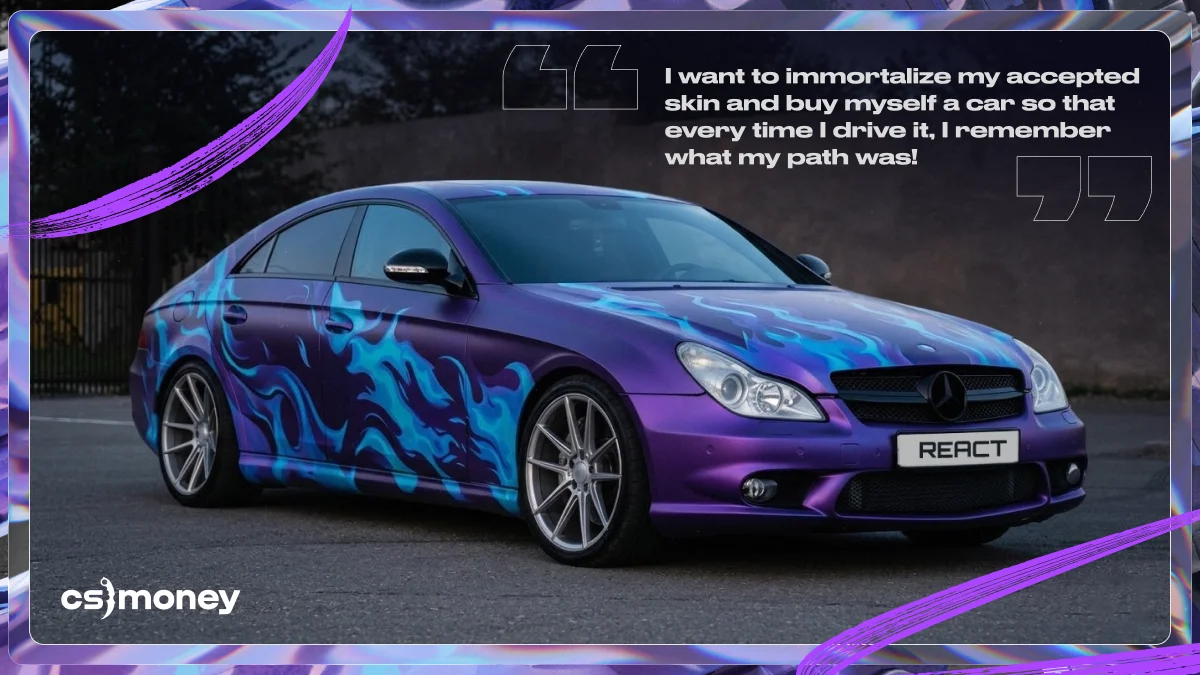
I achieved what I dreamed of, even though I did not get exactly what I expected. I am genuinely grateful my skin was accepted, but I have walked a very long road. To all the beginners or interested people: that this is a very, very hard path that probably will not drastically change your life right now. It will just give you a small, but maybe necessary, push to start.
I am happy I met amazing people who always supported me, helped me, taught me, and believed in me. I am especially grateful to my wife Alina, who did not just believe, but supported and helped me, and even in the hardest times, she cheered me up and gave me that positive energy I really needed.
How long have you been making skins? What got you into this, so to speak? Who inspired you and who did you learn from?
I have been fully making skins since 2020, but my very first work was made on December 30, 2014. I could not even publish it because I did not know I had to fill in some details. [laughs]
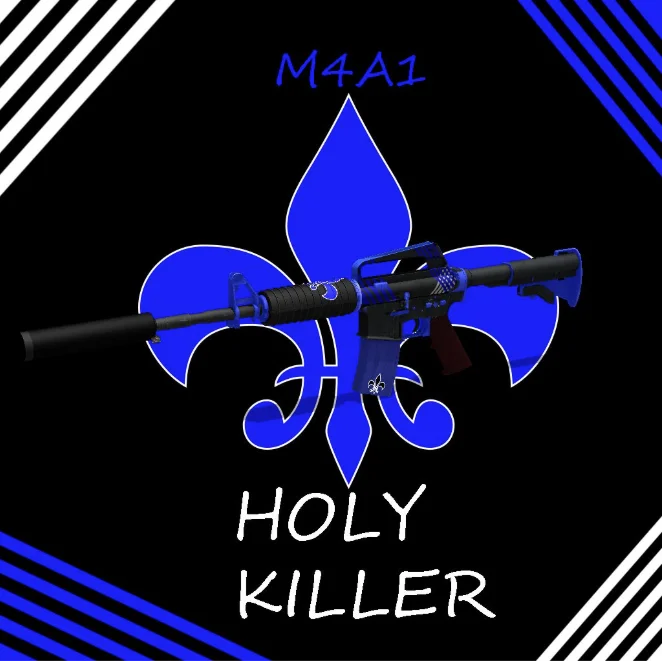
In 2020, I returned to the workshop thanks to a random video about Substance Painter. People make game textures in that program, and I immediately remembered skins. I downloaded the program, a model, and instantly started making skins. I liked it, so I kept going.
Later, I joined a group of skin makers, and at the beginning they helped me a lot with almost everything. Thanks to Lefty, Saychains, Michael3D, and kr1zer! Without them, nothing would have worked out and I would have quit.
I also want to shout out giants like apel8, Sparkwire, DasDas, Teo, Strenson, and emu. Their skins inspired me and always amazed me with their quality, design, drawings, and approach to work. They are all very strong skinmakers.
Lately, I have been inspired by 80s retrofuturism: the design approach of those years; materials that used to seem futuristic and impossible; the vision of designers back then. To me personally, it is an unimaginably beautiful style.
Important things during CS2 skins creation
What makes a skin memorable? Should a skin tell a story, or is visual impact more important?
Storytelling is important to me. The design should tell a story, and do it instantly: so that when a person looks at the skin while inspecting it in-game, they immediately understand what you meant. Unfortunately, players often do not care about the story, they only care about the visuals. Valve, on the other hand, probably values both at the same time in skins, because a strong piece of work should combine all these qualities.
Do you try to follow trends in the skin-making community or do you avoid them? Do you think simplicity or complexity works better for skins?
I used to try following trends. I did my own market analysis for each case to understand what motivates Valve to pick a certain work from a marketing perspective. After all, a case needs to sell, and for it to sell, you need those skins and that gold item people will open cases for. But one day, a skin maker named yago told me an important thing I always missed: "Listen, if guys make skins for the general market, the chances of a specific work getting noticed are lower, because people see it all as one big blur. They do not know what to choose from. If you make something, say, for fans of one specific thing, they (the users) will notice it and root for it because it will be what they want to see."
After that, I realized my approach was wrong. In Counter-Strike 2, simplicity stands out much more compared to complex skins.
***
You can get the Dead Hand Terminal with a Desert Eagle Firebreathing in the usual way for all CS2 players: through weekly drops. Of course, you can also purchase it on CS.MONEY or the Steam Community Market.