In Counter-Strike 2, you have the option to keep a close eye on all sorts of stats. Even though numbers don’t ultimately decide if you win or lose, keeping track of different stats can be pretty fun and a great way to step up your game. Today, the CS.MONEY Blog will break down ADR in CS2, KDA, and other important stat abbreviations.

Whether you are carrying the game or bottom-fragging, the main thing is to have fun and play by your own rules. Spice up your inventory with CS.MONEY!

What is KDA? Everything about the main stat
All stats can be split into three types: first in-game group, advanced, and esports. Let’s start with the easiest one: regular in-game stats that you can check by pressing Tab right in the middle of a match.
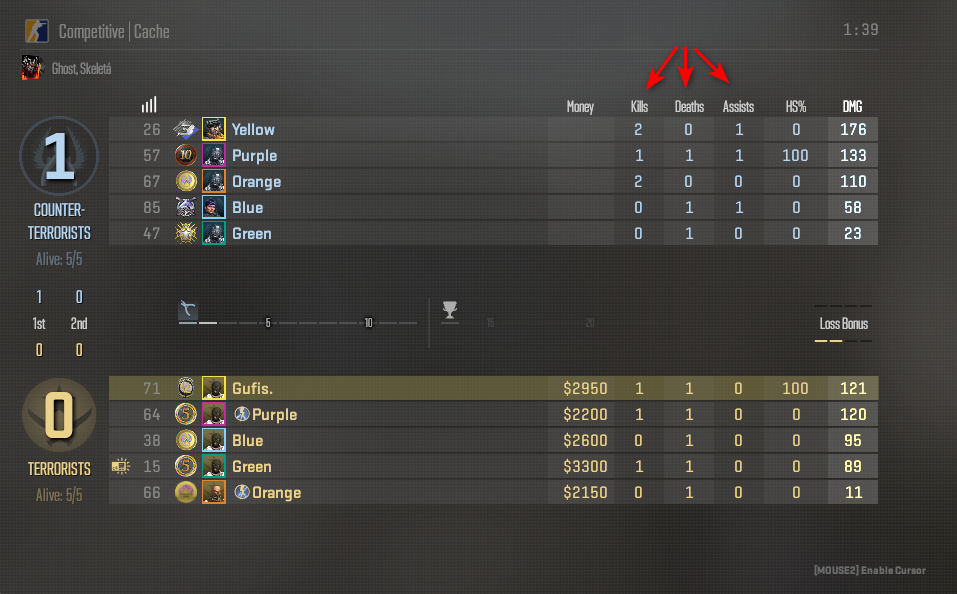
It is pretty simple here. We can see kills, deaths, assists, headshot percentage, and total damage for the match. Figuring out who is doing well is easy too. The more kills, assists, and damage, the better. Get more frags, die less = get the win.
Casual players usually focus on one specific number that sums up their success. It is called KDA (sometimes written as K/D/A), which stands for the ratio of kills and assists to deaths. Doing the math is super easy: add your kills to your assists and divide by your deaths.
Usually, players try to keep their KDA at least above 1. That means you are taking down enemies and helping with kills more often than you are dead spectating your teammates. Sometimes people just shorten it to KD. It is the exact same thing, but you don’t count the assists.

KDA or KD is the classic way to show off how good you are in basically any online shooter. But it is not the ultimate proof of skill. You could have a massive KDA just by stealing kills on enemies your teammates already weakened, leaving you with barely any total damage done.
Headshot percentage is even more subjective stat. It really just shows how often a player hits those flashy one-taps and gives a rough idea of how fast they drop their targets.
What is ADR in CS2?
So what actually shows true skill? Tryhard players have been looking at other stats for a while now. There are plenty of them, but let’s take it one step at a time. We will start with the most popular one: ADR.
ADR stands for average damage per round. This stat shows exactly what it sounds like: how much damage you deal to enemies on average every round. You figure it out by taking your total damage and dividing it by the number of rounds played to get your average damage output.
How to check your ADR during a match?
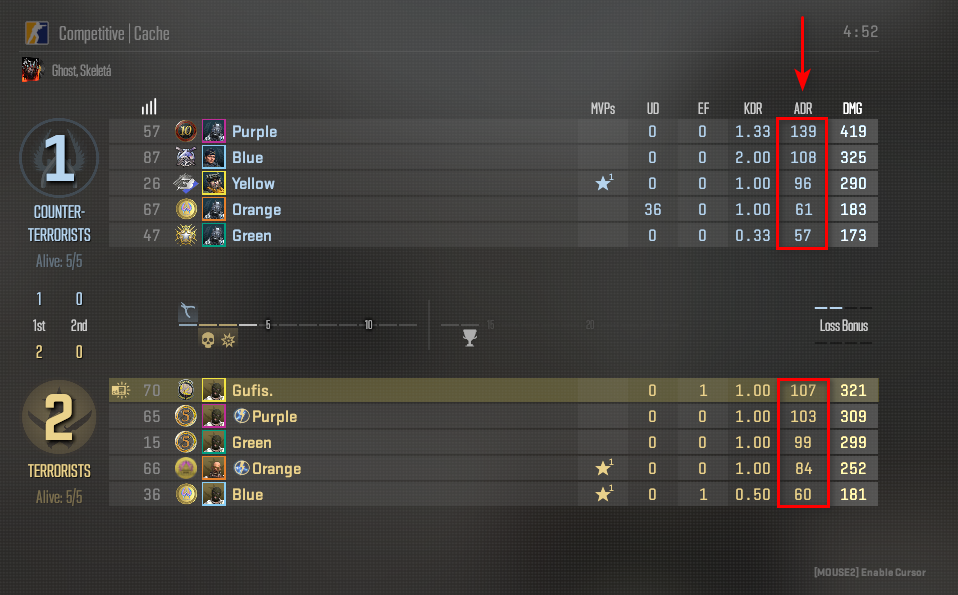
You can actually check your ADR, KD, and more right in the middle of a game, though it’s a bit hidden. To see the alternative stats screen, press Tab, right-click, and hit the graph icon. This flips the scoreboard and lets you see your ADR (and other cool info) live during the match. In this mode, you get to see stuff that was hidden before: exact ADR and KDA numbers, utility damage, and flash assists.
What CS2 ADR should you aim for?
Usually, if your ADR is over 100, you are doing awesome. It basically means you are trading your HP for enemy damage at least at a 1-to-1 ratio and totally pulling your weight for the team. In reality, hitting 100 ADR is extremely impressive, and even pro players struggle to keep it that high constantly.
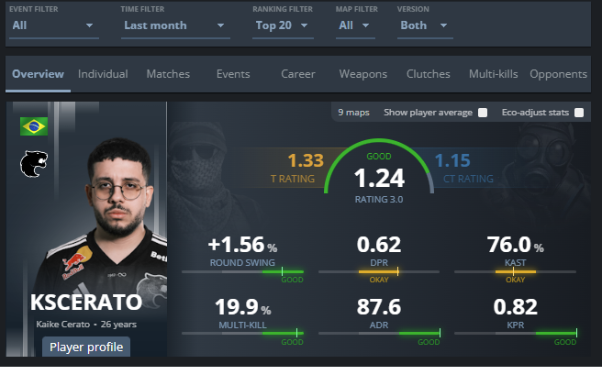
If you look at the top players on HLTV for April, the leader is the Brazilian star KSCERATO, who has an ADR of 87.6. To be fair, pro matches are built differently, which impacts the stats of even the best players. While 100 ADR in tier-1 esports is insane, cracked players in regular matchmaking or FACEIT can definitely push past a hundred.
To wrap it up, as a regular player, you only really need to care about two stats: KDA and ADR. You want your KDA above 1, and your ADR as close to 100 as possible. If you are hitting those marks, you can consider yourself a solid player for your rank. If you are lower, now you know what goals to set!
What are the UD and EF stats for?
Even though most players only focus on the two main stats we just talked about, it doesn’t mean the others are useless.
Grenades (also known as utility) add a huge layer to the game and often decide who wins the round. In lower ranks, people barely use them or just throw them randomly. But in higher ranks and esports, utility is a massive part of any team’s strategy.
There are two main ways to measure impact: utility damage (UD) and enemies flashed (EF). By the way, you can find both of these in-game just by switching your Tab scoreboard to the alternative mode.
As you probably guessed, these show how much damage you are doing with HE grenades and molotovs, and how often you are blinding enemies with flashbangs. Rating them is super straightforward: the higher the number, the better. Though with flashbangs, you gotta remember that blinding an enemy doesn’t always lead to a kill or bring any benefit, so the stat doesn’t mean your flashes are 100% perfect.
If a player’s utility stats are through the roof, it means they love throwing nades and actually know what they are doing. Watching how players with high utility stats throw their lineups can teach you some crazy new tricks, making you stand out from the average players at your rank.
Which stats should you care about?
| Stat | Reflection of your skill |
| KDA | High |
| ADR | High |
| Headshot percentage | Low |
| Utility Damage | Below average |
| Enemies Flashed | Low |
We’re not suggesting to neglect your aim, shoot less in heads, or throw fewer flashbangs. We’re simply saying that some stats are not popular among the community, and people are much more interested in ADR and KDA.
What is the FACEIT rating?
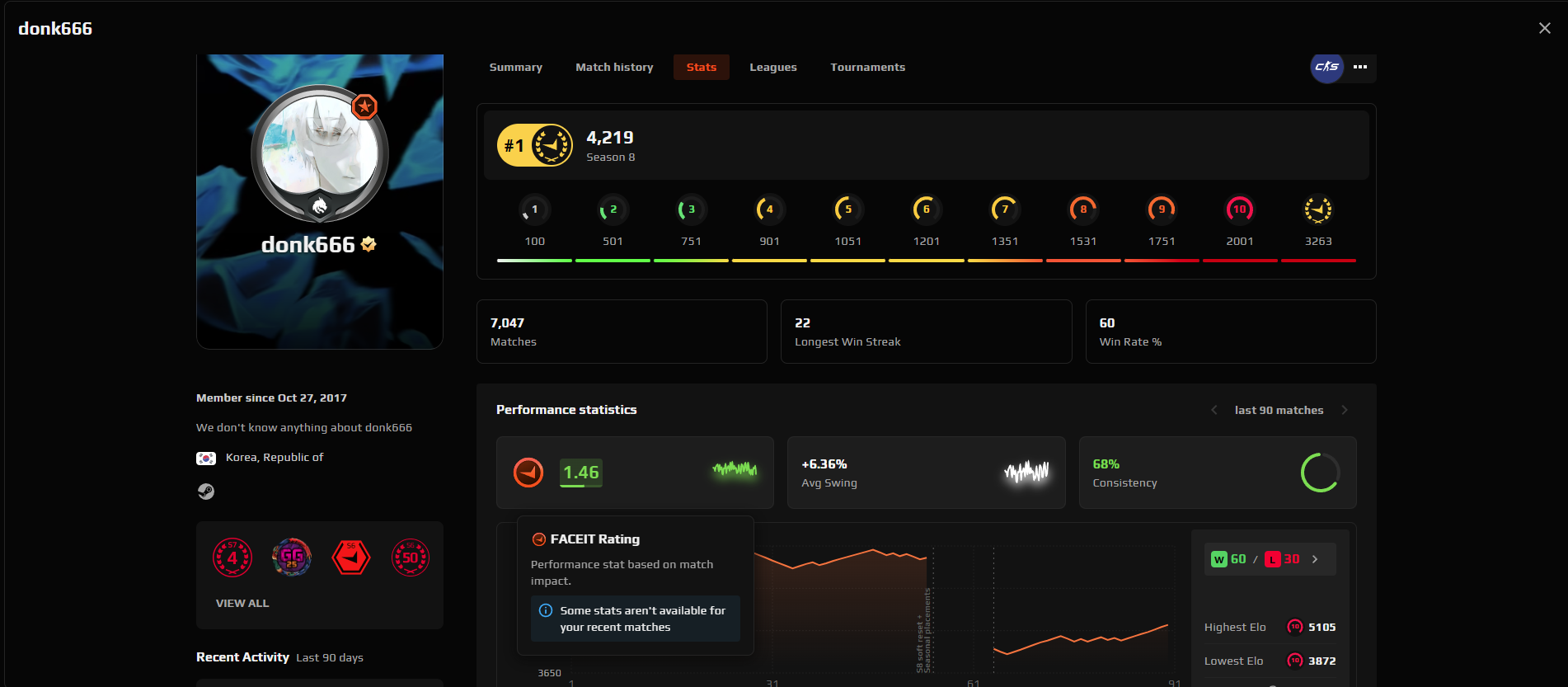
Since the basic and advanced stats in CS2 don’t give the full picture of a player’s impact, and everyone just wants one simple number to show how good they are, different platforms have come up with their own formulas.
In April 2026, FACEIT launched its own rating system. It looks at the actual impact of your actions on the whole match. If you pull off a sick 1v2 clutch and destroy the enemy’s economy, that counts way more than just getting a double kill when the other team is saving. It mostly boils down to how much your plays boosted your team’s chances of winning the round, and how big of a swing you caused.
According to FACEIT, their rating means this:
- A 1.4 rating means you played an absolutely insane match.
- A 1.1 rating shows you had a solid, positive impact.
- A 0.7 rating means you had a rough game where nothing was really working out.
What is HLTV Rating 3.0?
The HLTV rating tries to measure a player’s true impact in pro esports matches, where everyone has a specific role and job to do. Because of this, the most important thing they look at is the win probability of the round, which is exactly why FACEIT followed HLTV’s lead in their math.

Kills are also super important. The damage you deal and how often you stay alive matter slightly less, but they are still a huge chunk of your rating. Finally, multi-kills and how well you get trade kills also affect your 3.0 rating, just not as much as the other stats.
Just remember, even though stats have totally changed how people look at CS2, they aren’t everything. So don’t get completely obsessed with numbers. You can also be the hype person, keep the vibes positive, and lead your team to a win. Counter-Strike is a deep game with a lot going on, and that is exactly why we love it!