Counter-Strike 2 is a competitive shooter. In games like this, nothing feels worse than losing a duel because of a sudden FPS drop or an internet lag. Luckily, CS2 has built-in performance indicators. The CS.MONEY Blog explains which stats are available, what they mean, and how to lower var in CS2.
Get the most from the game with awesome skins! Where’s the best place to buy them? Of course, on CS.MONEY!

How to enable netgraph in CS2?
In Counter-Strike 2 there aren’t the usual three lines of info that you used to get with the net_graph console command in CS:GO. Instead, the game has telemetry you can turn on in the settings. In the current version of CS2 there is no net_graph and you can’t lower var in CS2, because that value simply doesn’t exist in the game.
Right now there are two ways to check your connection and the server’s behavior:
- use the console command cl_showfps 3;
- turn on the telemetry display in settings.
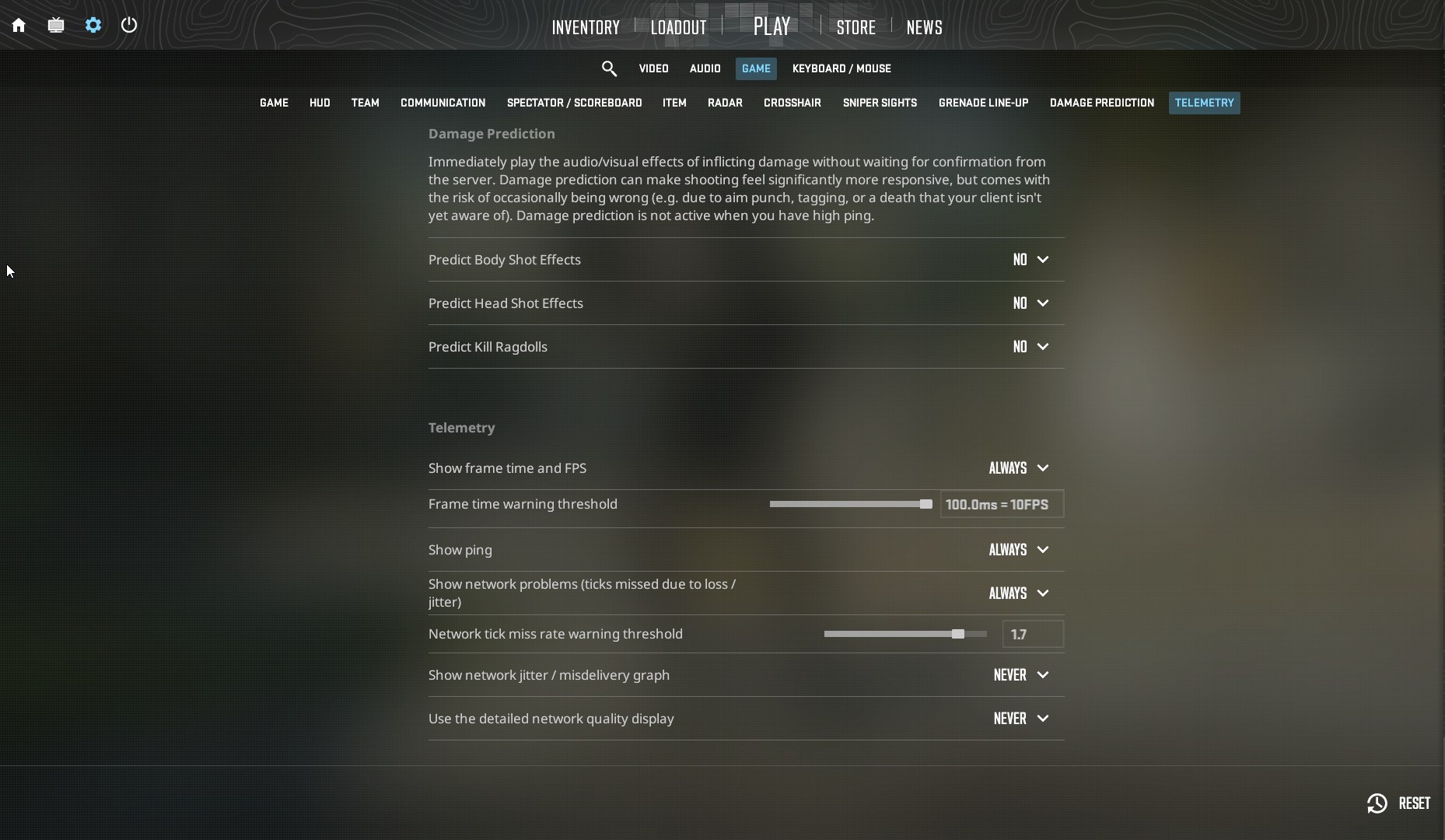
To enable netgraph in CS2, open the game, go to Settings, then the Game tab, and finally the last section: Telemetry. For full control, turn on everything and set it to always show. FPS, ping, jitter graphs should be on and always visible.
What do the stats mean?

If everything is turned on, you’ll see four lines of stats and two graphs on screen. Let’s break down each value. The first line shows the worst frametime: that number tells you how long the slowest of the recent frames took to render. Next to it, separated by a dash, you’ll see the current frames per second.
Frametime is an important stat. If it’s below 15 ms, things are good: the image is smooth and the game feels responsive. If frametime jumps to 40 ms, 50 ms or higher, expect microfreezes and choppy visuals.
Below that are the missed ticks and lost packets, and also jitter, which is basically ping spikes. Missed ticks and lost packets are shown in two lines. The top line shows values for packets from the server to the client, and the bottom line is the opposite direction.
If jitter graphs are enabled, they’re much clearer. They draw ping spikes as a line. There’s also a red “ceiling” at 20 ms. If spikes go over that limit, there’s a network problem. In normal conditions the graph rarely even reaches 10 ms.
Displaying data with cl_showfps
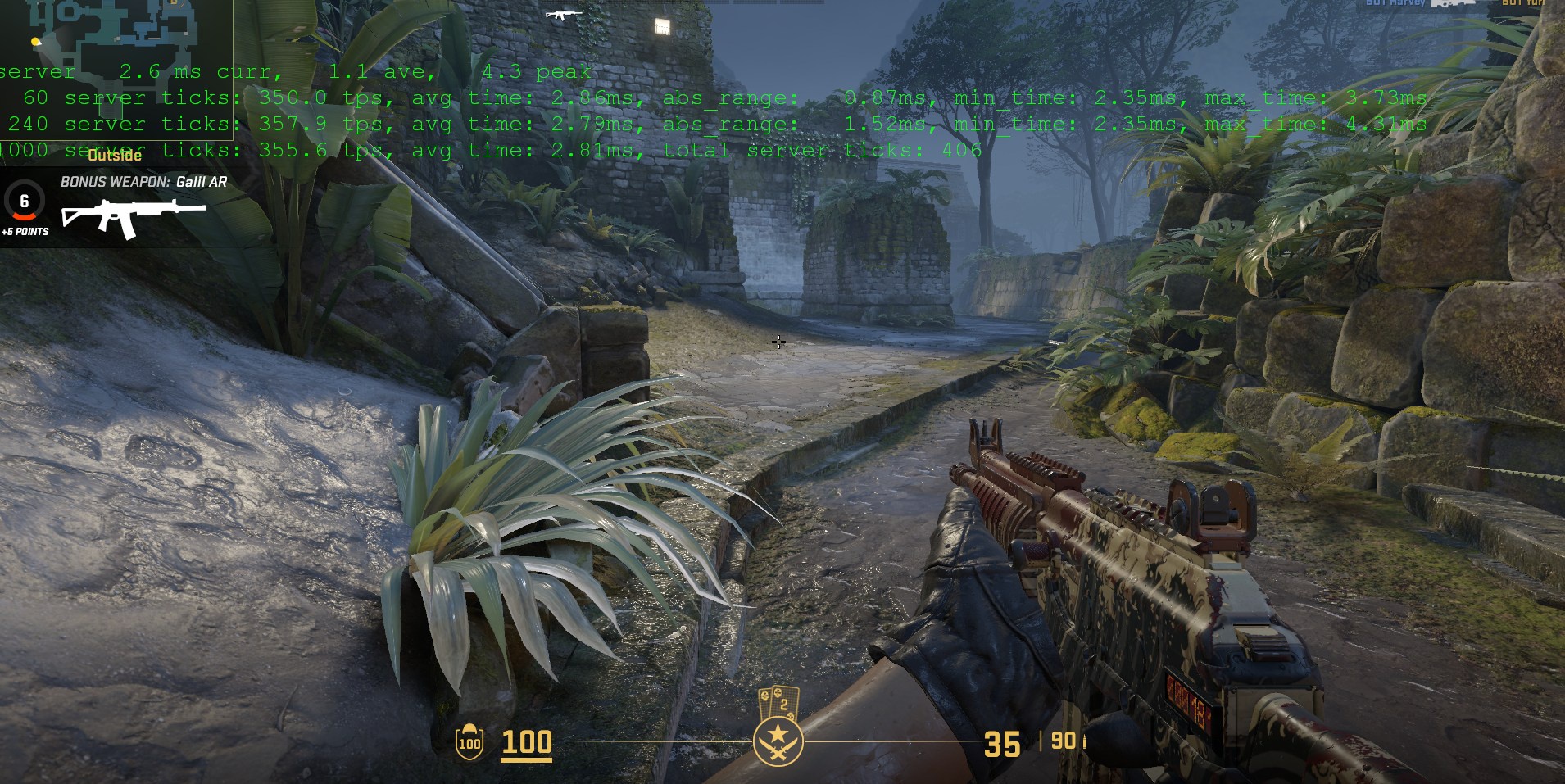
Besides those graphs, you can also show game-state info with the console command cl_showfps 3. With that value you’ll see server stats on screen; with cl_showfps 1 you’ll only see your computer’s FPS.
cl_showfps 3 helps you track server performance. Normally values there are measured in a few milliseconds. If numbers are in the tens instead of single digits, the server is struggling. You can also spot problems in the top-right corner. A red message about server processing issues is another sign the server can’t keep up.
How to find problems in CS2 using telemetry?

With all the stats turned on, you can figure out what’s wrong. There are three main issues:
- high frametime or low FPS;
- jitter that keeps spiking or high ping;
- lots of packet loss or missed ticks.
Let’s look at each problem and where it comes from, and how to try to fix it.
High frametime
If telemetry shows a high frametime (from 20 ms) that means the PC can’t render frames fast enough or does it inconsistently. There are many causes and many solutions. Luckily, we already wrote about how to increase FPS in CS2. Follow that guide to learn all the ways to boost game performance.
Jitter spikes
Ping plays a big role in how responsive the game feels. The lower the ping, the faster the server and client exchange data. Put simply, with low ping the server receives your commands faster. For a smooth game you want ping under 50 ms. With ping up to 100 ms you can still play, but it’s not ideal. Above 100 ms it becomes hard to play: too much time passes between your action and the server’s reaction.
Jitter shows how much ping changes. If jitter on the graph is above 20 ms, that’s bad. The connection is unstable and the game can feel unresponsive.
You can try a few simple steps to fix both problems:
- first, don’t play on Wi-Fi. Use a wired connection (Ethernet) straight to the PC; no wireless;
- second, stop any background downloads and reduce other uploads;
- third, make sure your router and PC network card are working and have up-to-date firmware/drivers.
If none of that helps, contact your ISP and work with their support team.
Lost packets
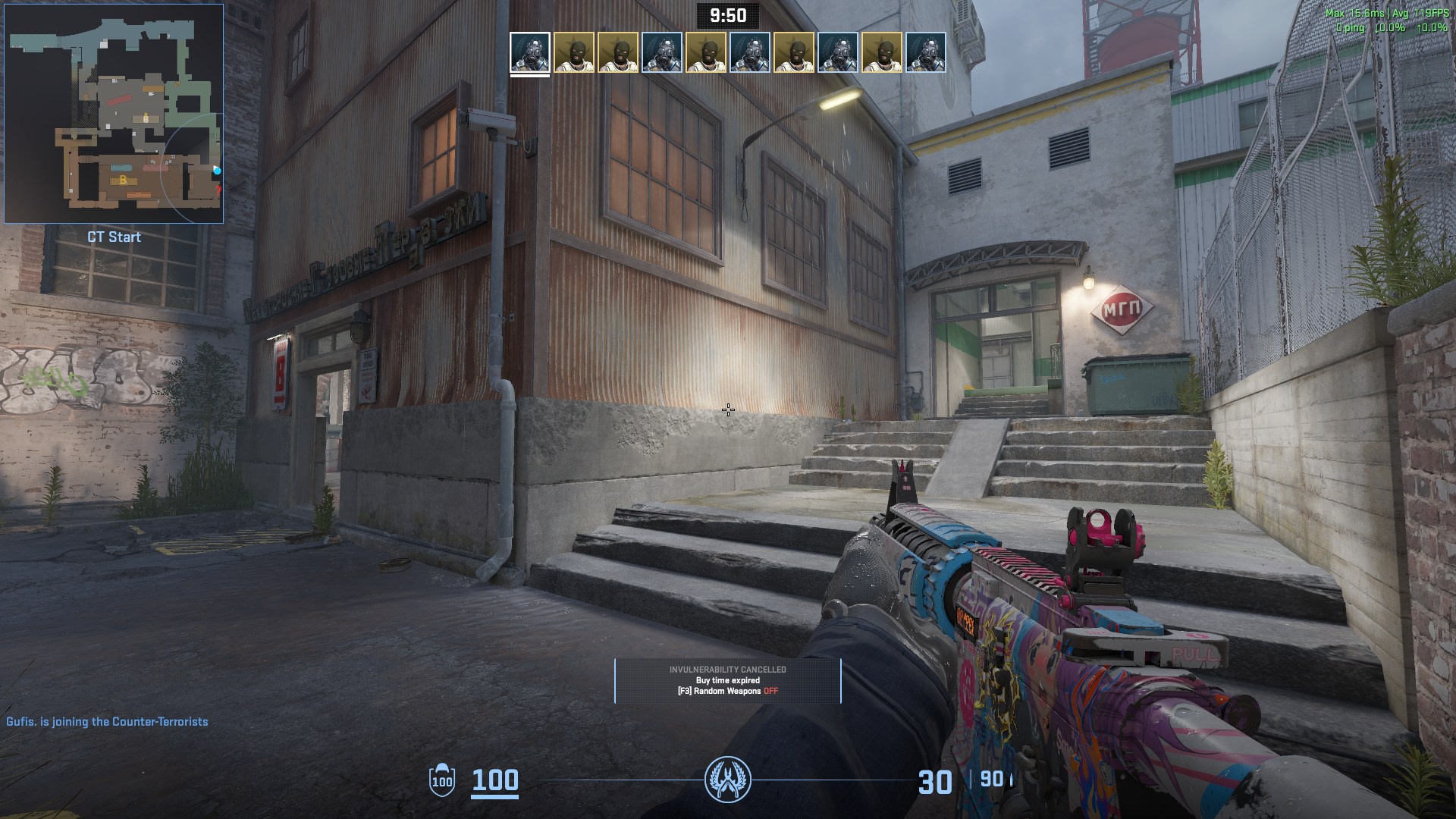
Packet loss or missed ticks cause the “bad registration” feeling. This is also a network issue and the three steps above often help here too. Also, packet loss can come from a damaged Ethernet cable. It’s a good idea to replace the cable just in case.
If Counter-Strike 2 is lagging, you can find the cause. The game has several indicators you can enable in settings. Depending on where the problem is, you might need to update drivers, change the connection type, or even upgrade your PC. The main thing is don’t try to fix things blindly. Turn on telemetry, identify the exact issue, and then fix it.